


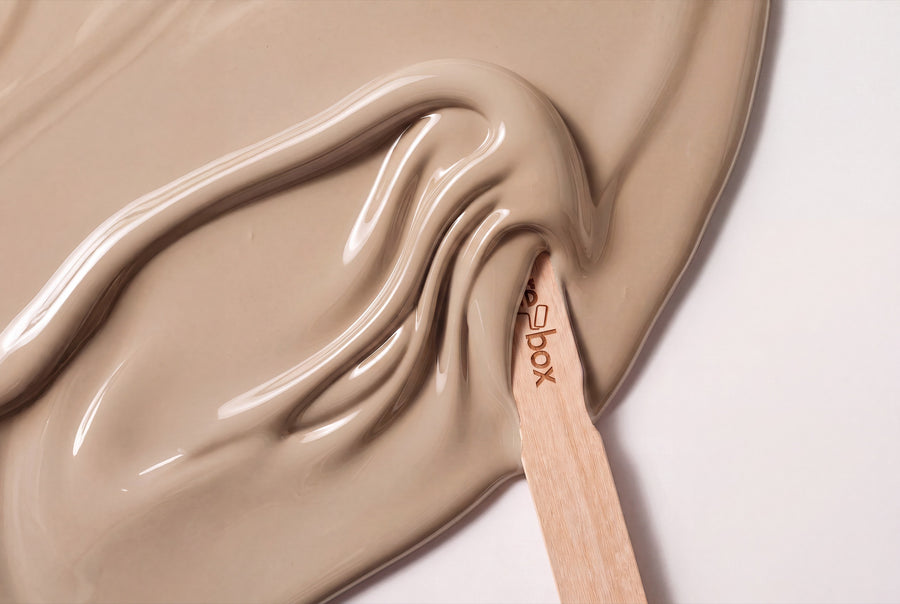
Beige Lacquer Colours gathers the shades that don't shout in a room but carry it: 15 nuances between cream, sand and pale stone, every one a satin-gloss furniture lacquer. Beige is the colour you choose when the piece is meant to stay put, not become the room's talking point.
Buy beige furniture lacquer: 15 shades, satin-gloss, in 750 ml
All 15 shades in this category are based on re-box protect, the furniture and multi-surface lacquer for furniture, wood and interior surfaces. There's one tin size, 750 ml, and one finish, satin-gloss. Tinting happens only after you order — so there's no pre-mixed beige waiting on a shelf; yours gets mixed specially.
If you want the same shade on the wall too, you'll find it there in matt or satin-matt. The lacquer itself stays satin-gloss. On fronts and door frames, that's the finish that makes sense, because re-box protect is built to withstand mechanical wear, everyday marks and outside influences.
Fifteen beige shades, from cream to stone
Beige isn't one colour — it's a range. Between the lightest and the deepest shade in this category sit several undertones: yellowish, rosé, grey, earthy. We've sorted them into four groups so you don't have to compare 15 tiles at once.
Creamy and nearly white
The lightest group marks the transition to white, but keeps a trace of warmth. Blanc Épuré No. 55 Lack is the clearest of the three and stays calm even over large surfaces. Neige Douce No. 42 Lack feels a touch softer. Lait Vanillé No. 56 Lack carries the most noticeable yellow of the three — on a chest of drawers in a north-facing room, that's exactly what keeps the space from feeling cold.
Sand, linen, paper
The mid-tone beiges are the workhorses of the family. Lin Clair No. 58 Lack and Linen Wash No. 2 Lack both lean towards unbleached linen, one lighter, the other richer. Canvas Cover No. 30 Lack brings raw canvas to mind. Cashmere Dune No. 1 Lack is the shade for anyone who wants beige without it looking like beige.
Chalky and faintly grey
Here beige takes on a cool edge without turning cold. Craie Ancienne No. 60 Lack and Chalkstone No. 16 Lack both carry that chalky quality in name and in character. Pierre Douce No. 41 Lack leans towards pale natural stone, Wisp No. 4 Lack stays delicate and understated, Sel Marin No. 54 Lack has that salty, slightly broken base tone that pairs well with light oak floors.
Warm-toned and deeper
At the lower end of the family, beige becomes a colour in its own right. Soie Blush No. 59 Lack brings a quiet rosy undertone, turning a simple chest of drawers into a piece with presence. Stonecellar No. 17 Lack is earthier, Hippo Shade No. 19 Lack is the darkest of the range and the choice when a piece of furniture should gain weight without turning black.
Why beige is never neutral
Beige has a reputation for being non-committal, but it isn't. Every one of these shades leans in a direction — yellow, red, grey — and that direction decides how the piece of furniture sits in the room. A yellow-leaning beige makes a surface feel friendly and a little old-fashioned in the best sense. A grey-leaning one makes the same surface feel matter-of-fact.
Light amplifies that direction. In a north-facing room, with cool, even light, grey beiges lose their warmth and drift visually closer to grey. Warm creams, on the other hand, hold their ground. In a south-facing room it's the reverse: midday sun makes yellowish tones read stronger than they did on the sample, while chalky shades stay comfortable precisely then.
Which is why there's only one reliable test: look at the sample on site, morning and evening. The Farbmusterbox 65 Stk contains every shade as a sample — on the cupboard door, where the lacquer will eventually sit, you'll see more in two days than in two hours of comparing on screen.
What beige pairs with
Beige gets along with almost anything natural, and with very little that's loud. As a rule of thumb: the warmer your beige, the better it suits warm wood — oak, cherry, walnut. The cooler and chalkier it is, the better it suits pale woods, linen, ceramics and natural stone.
- 👉 Brass and aged brass as handles: lift warm beige tones and look more refined against chalky nuances than glossy chrome.
- 👉 Black fittings: give light creams definition and turn a soft piece of furniture into a graphic one.
- 👉 Linen, wool, jute: echo the material character without repeating the colour.
- 👉 White alongside: a pure white immediately makes beige look darker. If you're pairing it with white, choose a broken white — otherwise the beige beside it looks dirty rather than warm.
Where beige lacquer works in everyday life
Kitchen
On fronts, beige is the alternative to white that doesn't show every fingerprint. Lacquer the doors unhung and lying flat, so nothing runs. You'll find out how to plan the project in Küche streichen: Anleitung, Kosten, Farbe.
Living room
A sideboard in a deeper beige takes the ordinariness out of a bright room without making it feel smaller. Together with wood and a broken white on the wall, you get the layering that pure white spaces often lack.
Bedroom
Creamy tones are the obvious choice here, because they stay warm under lamplight. A wardrobe, bedside table and bed frame in the same tone calm the room far more than three different types of wood.
Hallway
The hallway rarely gets daylight and has plenty of edges. A light, warm beige on doors and frames opens it up; a chalky tone on a hallway bench sets a calm accent. Because everything here gets touched constantly, protect's resistance to mechanical stress isn't a luxury — it's the reason to choose this product.
Home office
Shelves in sand or linen let books stand out instead of competing. If you're lacquering the desk too, think about the fine sanding beforehand — work surfaces show every unevenness.
Preparation, surface and finish
The process is the same for every beige tone: clean the surface, sand glossy old lacquer to a matte finish, remove all dust, then apply primer, then re-box protect. What the surface needs to bring is the same for every tone: clean, dry, load-bearing and free of loose particles. Tape off any edges that should stay sharp beforehand — you'll find tips on this in Richtig abkleben ohne Farbunterläufe.
Light beige tones are forgiving, because on light surfaces they barely let any of the base colour show through. Over dark old lacquer or raw, highly absorbent wood, though, you'll need patience and two clean coats of lacquer instead of one thick one. It's better to work in two thin coats than one heavy one: lacquer applied too thickly runs at vertical edges and dries unevenly.
The same beige tone for the wall
Almost every tone in this category also exists as a wall paint. Under Beige you'll find the wall version, available in two finishes: base one is matte, silk matte is satin-matte, hard-wearing and easy to clean. Both come in 2.5 L, 5 L and 10 L.
As a guide for two coats: 2.5 L covers approx. 8–10 m², 5 L approx. 15–20 m², 10 L approx. 30–40 m². On very dark or uneven surfaces, consumption may increase. Tone-on-tone doesn't look flat, by the way, but layered: the matte wall absorbs light, the satin lacquer gives it back.
Questions about beige furniture lacquer
Which beige tone suits a dark room?
Choose a warm, creamy tone rather than a chalky grey one. Without direct daylight, grey-tinged beige tones lose their warmth and quickly look grey. Lait Vanillé No. 56 or Neige Douce No. 42 hold up better under lamplight.
Does beige lacquer yellow over time?
We can't say, as we have no tested data on this — and we won't claim what isn't proven. What is proven: re-box protect is resistant to mechanical stress, everyday soiling and outside influences.
How many beige tones are available?
15 tones, from near-white creams to deep, earthy nuances. Each one is mixed individually once you've placed your order.
Can I lacquer kitchen fronts made of melamine?
On smooth, sealed surfaces, preparation is what counts. Clean the surface thoroughly, sand it matte, remove the dust, then apply re-box core as a primer and the lacquer on top. Without this build-up, no lacquer will hold up in high-touch areas.
Is the tone also available as a wall paint?
Yes, almost every beige tone exists in both forms — once as a lacquer, once as a wall paint. The wall version comes matte or satin-matte in three container sizes, the lacquer only in satin finish, in 750 ml.
Can I return the lacquer if the tone isn't right?
No, individually mixed colours are excluded from withdrawal and exchange. Since every can is only mixed after you order it, testing a sample beforehand is the safe way to go. For help with colour choice, finish and quantity, Anna, re-box's digital colour consultant, is here for you.


