


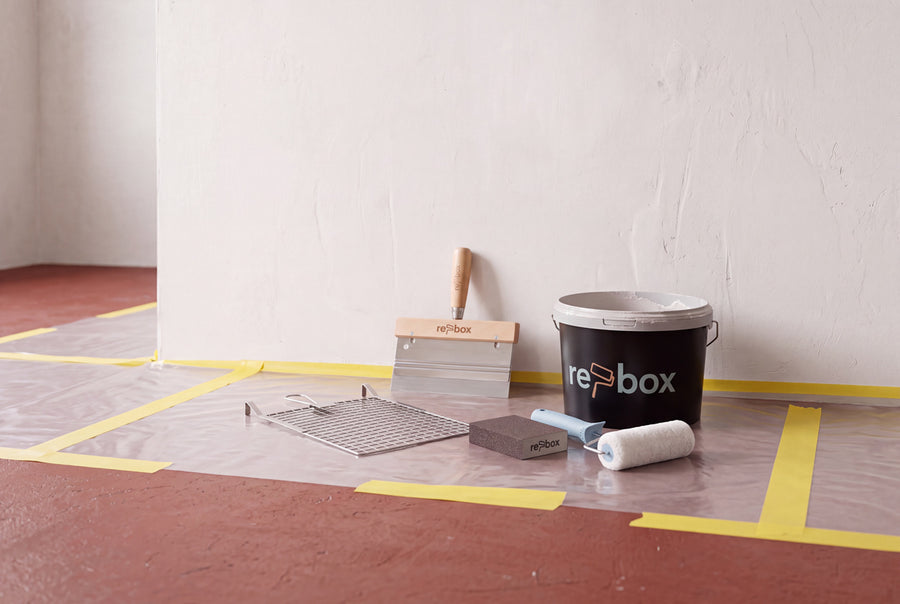
Most of what goes wrong when painting goes wrong before the first coat ever touches the wall. That's why re-box's paint accessories cover not just what you apply the paint with, but everything that gets the surface right beforehand. 22 items, all matched to each other for wall and lacquer work.
Buy painting accessories: 22 items for prep, painting and lacquer
The range follows the course of a project. First comes preparation: masking, covering, filling, sanding. Then application: rollers, brushes, tray, roller grid. In between are the small things you only think of once they're missing — a stirring stick, gloves, a cloth.
Two groups deserve particular attention. One is the tool you'll hold constantly: roller, brush, tray. Here, care in choosing pays off, because you feel the difference with every stroke. The other is consumables — tape, film, sanding blocks, gloves. It's worth keeping a spare on hand rather than having to go out again halfway through the project.
Everything can be ordered individually, so you never end up with a set half of which you never touch. Delivery takes 3–5 working days from receipt of payment, within Germany.
Before the first coat of paint
Masking and covering
Clean edges come from the tape, not the roller. The tesa® Precision Mask – Precision Tape draws the line between wall and ceiling, along skirting boards and around sockets. The Cover Film 2 x 25 m protects the floor, and you can tuck it right under the tape.
Holes, cracks and dents
Every unevenness becomes more visible after painting, not less. Use the Repair Filler 1 kg to fill drill holes and cracks; it has strong filling power and is easy to work with. Apply it with the Double Spring Filling Knife, and if you fill regularly, it's worth adding the matching lifter for filler.
Sanding
After filling comes sanding, and always before lacquering. The Sanding Block – Grit 120 takes down filler edges and old ridges; for the fine sanding before lacquering, use the finer block with Grit 220. Afterwards, always remove the dust — it's the most common reason for a rough lacquered surface.
You'll find a full guide on getting a wall ready from scratch in Preparing walls the right way.
Application: rollers and brushes
For the surface
Walls and ceilings get the large roller. The Paint Roller with Frame, Large - 25cm is the standard choice for this; you'll find all sizes and replacement parts under Paint Rollers. For lacquered surfaces, there's the fine Lacquer Roller Small - Replacement Roller, 11 cm, which leaves less texture.
For corners, edges and profiles
What the roller can't reach, the brush handles. The Paint Brush 70 mm – Wooden Handle is meant for the joins at ceiling and skirting, while the Lacquer Brush 35 mm - Synthetic Bristle is for door profiles, glazing bars and furniture edges. Both work best when you only dip them halfway into the paint.
Working cleanly: tray, grid, stirring stick, gloves
Fill the Paint Tray - Small with only as much paint as you'll use in the next few minutes. Hang the Professional Metal Roller Grid in the bucket if you're working straight from it — a properly wiped roller won't drip onto the floor.
Before opening any tin: stir. That's what the Stirring Stick - 30.5x3 cm is for, since pigments settle when left standing, and unstirred paint covers unevenly. 2 Nitrile Gloves are there for your hands, and the Microfibre Cloth 40x42 cm for fresh splashes — wiped away wet, a splash is harmless; dried, it's a project of its own.
One small habit that pays off in the end: don't leave leftover paint standing in an open bucket — close the lid again. Your paint was mixed specifically for you, and you may well need it later for touch-ups. Label the bucket with the room and date, so you're not searching next time.
Reaching height without constantly switching ladders
Ceilings, upper wall edges and stairwells are exactly why the Telescopic Pole - Large 78.5 - 131.5 cm exists. It extends your reach far enough that you can roll longer stretches in one go, instead of moving the ladder for every stretch. The small version is enough for standard room heights and wall surfaces, the large one for stairwells and tall period rooms. You'll find which pole fits which frame in the details for each pole.
The real advantage isn't convenience — it's the result: the less often you switch, the fewer joins you make, and joins are what you notice later.
Which tool belongs with which re-box paint
For matt and satin-matt wall paints, you'll need a roller, brush, tray and stripping grid. For lacquer work, there's an extra step: first the re-box core adhesion primer, then the lacquer — with fine sanding in between. On the tool side, that means a fine lacquer roller instead of a wall roller, and a lacquer brush instead of a paint brush.
And before the tools even come into play, there's the colour decision. With the Farbmusterbox 65 Stk, you can see all the shades in your own light before ordering paint, which is mixed individually for you and therefore excluded from the right of withdrawal.
The order you'll need it in
- 👉 Clear out furniture, cover the floor, tape the edges
- 👉 Fill holes and cracks, let dry, sand, remove dust
- 👉 Prime if the plaster is highly absorbent or fresh
- 👉 Stir the paint, fill the tray, cut in the corners with the brush
- 👉 Roll the surface in strips, wet on wet, without pausing in the middle of the wall
- 👉 Remove the tape while the paint is still not fully dry
You'll find out how to remove the tape without paint bleeding underneath in Richtig abkleben ohne Farbunterläufe. In most cases, the room is usable again after about 24 hours.
Common questions about paint accessories
What do I need at minimum for a room?
A roller with a frame, a brush for the corners, a paint tray, tape and masking film. That's enough to manage a normal room. Everything else — filler knife, sanding block, telescopic pole — depends on the condition of your walls.
Do I need different tools for lacquer than for the wall?
Yes, for lacquer you'll use a fine lacquer roller and a lacquer brush. Wall rollers leave a texture on smooth surfaces that stands out on doors and furniture. Lacquer work also involves fine sanding before application.
Do I really have to stir wall paint?
Yes, otherwise it covers unevenly. Pigments settle while standing, and the first strokes from an unstirred bucket look different from the last. A stirring stick and half a minute is all it takes.
When do I need to prime?
When the plaster is highly absorbent or fresh. A primer isn't essential, but it ensures even drying and reduces consumption. For lacquer work, however, the re-box core adhesion primer is a fixed part of the process.
Which grit should I use for sanding?
120 for filler edges and old unevenness, 220 for fine sanding before the lacquer. Coarse first, fine after — and remove the dust after each sanding, as otherwise it settles into the fresh coat.
Can I reuse brushes and rollers?
Yes, if you wash them thoroughly right after painting. Once paint has dried, you can't get it out of the bristles again, and a hardened roller will leave visible streaks next time. Plan the washing as the last step of the job, not as a task for the next day.
How long does delivery of accessories take?
3–5 working days from receipt of payment. Shipped by parcel within Germany. If you order paint and accessories together, both arrive in the same delivery.


