


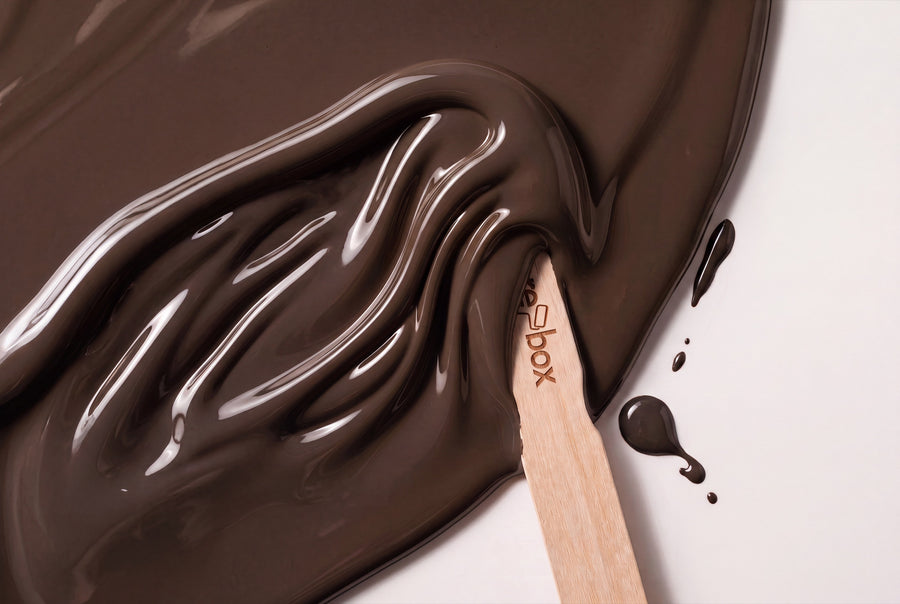
Brown lacquer colours sit between wood and earth. They pick up the tone that floorboards, table and door frame already bring into the room, and turn it into something deliberate. You'll find ten of them here, from pale chalk brown to a brown that looks almost black in evening light.
Buy brown furniture lacquer: ten shades from chalk to charcoal
If you want to buy brown furniture lacquer, you're rarely looking for just any brown. You're looking for the one that won't look cheap next to your existing oak. Ten candidates stand ready here, from chalky pale through taupe-grey and red-brown to charcoal-dark.
Each of these shades is re-box protect, the satin-sheen furniture and multi-surface lacquer for furniture, wood and interior surfaces. It comes in a 750-ml container, in one sheen level, with no agonising over the finish. The colour only goes into the tin after your order: each shade is mixed individually for you. That explains the delivery time of 3 to 5 working days from receipt of payment, and it explains why mixed paint is excluded from the right of withdrawal. If you're torn between two brown shades, the Farbmusterbox 65 Stk is therefore the smarter first step than a tin that turns out not to fit after all.
Why brown instantly calms a room
Brown isn't a primary colour but a result: red and yellow with a share of black. That's exactly why there are so many browns that have surprisingly little in common with each other. A red-tinged brown feels rich and close. A yellow-tinged one feels dry and friendly. A grey-tinged one feels cool and keeps its distance.
On a lacquered piece of furniture, this difference shows up more clearly than on a wall, because the satin sheen gathers light instead of absorbing it. If the piece stands in a north-facing room, daylight stays cool and slightly bluish. Warm browns with a red core hold their own there, while grey-tinged ones quickly slip into murkiness. Facing south, the light turns golden, and the same chest of drawers looks two shades warmer than on the sample card in your hand. So look at the shade twice: once at midday at the intended spot, once in the evening under artificial light.
The ten brown shades, sorted from light to dark
Brown is a wide family. Four groups help with sorting.
Pale brown with chalk and linen
Craie Ancienne No. 60 Lack is the palest brown in the range, chalky, almost beige, and the right choice for furniture that isn't meant to play the lead in the room. Canvas Cover No. 30 Lack has more linen character, a warm light brown that looks very natural next to unpainted wood. Hippo Shade No. 19 Lack sits a touch darker and greyer, already leaning towards taupe.
Taupe: brown tipping into grey
Stonecellar No. 17 Lack is the coolest brown here, stony and restrained. In rooms with plenty of grey and concrete, it's the brown that fits in rather than asserting itself. Berry Veil No. 21 Lack adds a berry undertone. On a chest of drawers front, it looks almost mauve in the afternoon and clearly brown again by evening. If you like taupe but want a bit of life in it, this is the shade for you.
Woody brown with a red core
Chêne Antique No. 51 Lack is the shade for anything standing next to old oak: warm, mid-brown, with a clear red share. Bois Impérial No. 52 Lack goes deeper and richer, a brown with weight that makes small furniture look bigger. Velours Brun No. 50 Lack sits between the two and is the softest of the three: velvety in impression, with no hard edge towards red.
Dark brown to charcoal
Brun Moka No. 53 Lack is roasted coffee, dark enough for a whole run of kitchen cabinets and still recognisably brown. Charbon Nuit No. 49 Lack takes the last step: a very dark brown by day, barely distinguishable from black by evening. Both need light nearby, or all that remains of the furniture's shape is a dark block.
What brown pairs well with
Brown doesn't like competition on equal footing. Two similarly dark browns in the same room usually look like an accident. Clear distance works better: one dark piece of furniture, one light surrounding.
- ✔️ Broken white instead of pure white: Blanc Épuré No. 55 Lack on the door leaf and skirting lets a brown piece of furniture in front really come into its own.
- ✔️ Warm woods like oak, walnut and cherry sit close to the red-brown shades. The lacquer should therefore be clearly lighter or clearly darker than the wood next to it.
- ✔️ Brass, leather, linen, cork and unpolished stone are the materials that give brown the least trouble.
- ✔️ As a counterpart, muted green works better than blue, because both families share the same earthy base.
- 👉 Cool greys suit the taupe nuances, not the red-brown ones. This rule saves most wrong purchases.
Where brown lacquer actually ends up in the house
Living room
Sideboard, back of a shelf, coffee table frame: in the living room, brown usually carries the largest piece of furniture. If you don't dare use a dark shade like Brun Moka No. 53 across a whole front, paint the back panel of an open shelf first and see after an afternoon whether the direction feels right.
Bedroom
Here, the soft tones win. Velours Brun No. 50 on a nightstand or an old chest of drawers takes the hardness out of a room without making it dark. Keep large surfaces in the bedroom light and use the brown as an accent instead, otherwise the room will feel smaller than it is in the morning.
Kitchen
Kitchen fronts are where a lacquer has to prove what it can do. re-box protect stands up to mechanical stress, everyday soiling and external influences. Dark brown tones show fingerprints less clearly than deep black.
Hallway and staircase
In the hallway, brown is the tone that absorbs signs of wear instead of highlighting them. Doors, frames and stair stringers in a medium brown warm up a narrow passage without darkening it. For guidance on the staircase, take a look at Treppe streichen: Holztreppe Anleitung, and for doors without removing them, see Tür lackieren ohne Ausbauen.
Silk gloss on furniture, matte on the wall
The lacquer has one sheen level, the wall paint has two. The silk gloss of protect is intentional on furniture: it traces edges and makes the surface wipeable. On the wall, you want the opposite, a surface that scatters light. That's what re-box base one in matte and re-box silk matte in satin matte are for, the latter especially hard-wearing and very easy to clean.
The lacquer build-up happens in two steps: first re-box core as an adhesion primer, then protect. The surface must be clean, dry, load-bearing and free of loose particles, otherwise even the best tone won't help. For coverage, plan on about 8 to 10 m² per 2.5 L of wall paint with two coats, about 15 to 20 m² per 5 L and about 30 to 40 m² per 10 L. The lacquer comes in 750 ml, and how far the tin goes depends on the size and absorbency of the furniture: measure the surfaces beforehand instead of guessing.
The same brown tone for the wall
Almost all colour names exist twice: once as a lacquer for furniture and wood, and once as a wall paint. Painted tone-on-tone, the boundary between wall and built-in furniture disappears, and the room feels larger.
You'll find the full range under Brown. Especially popular are the pairs: Craie Ancienne No. 60 as a light wall tone with the matching lacquer on the doors, Chêne Antique No. 51 for rooms with lots of wood and Brun Moka No. 53, when the wall is meant to be the dark surface and the furniture in front of it stays light. Important to know: wall paint and lacquer are two different materials. The colour tone matches, not the product.
Frequently asked questions about brown lacquer colours
Which brown lacquer tone suits oak?
Chêne Antique No. 51 lacquer is the most obvious choice, because it has the same warm red undertone as oiled oak. If you want more distance from the wood, go up to Craie Ancienne No. 60 lacquer or down to Brun Moka No. 53 lacquer. Two brown tones placed close together quickly look indecisive.
Can I paint brown lacquer over already lacquered furniture?
Yes, as long as the old coat is firmly attached. The surface must be clean, dry, load-bearing and free of loose particles. Apply re-box core first as an adhesion primer, then re-box protect in the desired brown tone.
Is one tin enough for a chest of drawers?
That depends on the size of the piece and how many coats you apply. The lacquer comes in a 750 ml container, and the only reliable method is to measure all surfaces to be painted beforehand. On doors, fronts and drawers, both sides count, which is often forgotten.
Don't dark brown tones feel oppressive?
On large wall surfaces they can, on furniture almost never. A sideboard in Charbon Nuit No. 49 lacquer looks like a calm block against a light wall, not a dark hole. What matters is the contrast with the surface behind it, not the darkness of the tone itself.
Can I test a brown tone beforehand?
Yes, with the colour sample box featuring all 65 tones. Hold the sample where the furniture will later stand and look at it in daylight and under artificial light. Brown changes noticeably between north and south light.
Can I return mixed brown lacquer?
No, individually mixed colours are excluded from withdrawal and exchange. This also applies to renovation boxes once they contain mixed paint. Separately marked white goods can be returned as long as they are undamaged and in their original packaging.


