


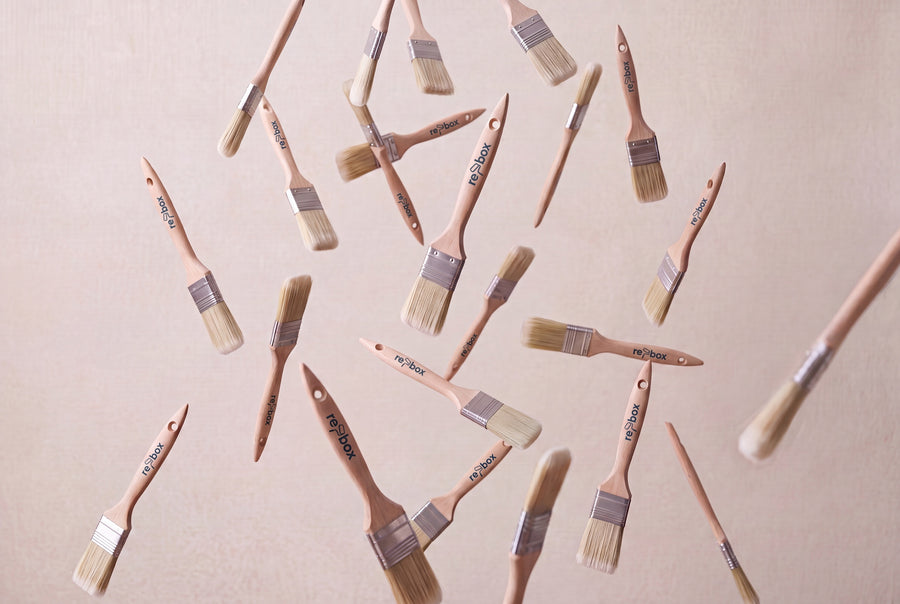
At re-box, brushes are the tool for everything a roller can't handle: corners, ceiling joins, skirting edges, window reveals, door panels, glazing bars. Instead of a shelf full of variants, you'll find exactly two here — a wide one for the wall, a narrow one for lacquer. Together, they're chosen to cover almost every project at home.
Buy brushes for wall paint and lacquer
This category includes two brushes. The Malerpinsel 70 mm – Holzgriff is the wide one: it cuts in the joins at the ceiling, corner and skirting before the roller takes over the open area. The Lackpinsel 35 mm - Kunstfaser is the narrow one: its synthetic bristles draw the lacquer out smooth instead of leaving it in ridges.
All of re-box's paints go with it. The wall paint comes matt as re-box base one (matt) and silk-matt as re-box silk matte WEISS (seidenmatt), each in 2,5 L, 5 L and 10 L. For furniture, doors and stairs, there's the furniture and colour lacquer re-box protect in 750 ml. Around 69 wall paint shades and 66 lacquer shades are available to choose from, and each one is only mixed individually once you've placed your order — including the white shades.
Why light reveals every brushstroke
The brush does its work where the light hits the wall at the sharpest angle: up at the ceiling join and along the side of the window. That's exactly where you'll see overlaps if the pre-painted edge had already dried before the roller arrived.
A room facing north gets soft, even light. It forgives irregularities, because hardly any raking light occurs. In a room facing south, a hard band of light moves across the wall over the course of the day, exposing every edge. Paint in smaller sections there and work wet on wet: first the edge with the brush, then straight away the area with the roller, wall by wall rather than room by room.
How much a shade stands out also depends on the shade itself. If you're not sure, get the Farbmusterbox 65 Stk beforehand and hold the sample up against the wall you want to paint, morning and evening.
The two brushes and when to use which
Malerpinsel 70 mm for wall and ceiling
At 70 mm, it's wide enough to pull an edge in one stroke, and narrow enough to hit it precisely. Use it for the ceiling join, for inside corners, for the strip above the skirting board and around sockets. Dip only the bottom third of the bristles and wipe off the excess at the rim — an overloaded brush drips, and the drip shows up later as a run.
Lackpinsel 35 mm for doors, furniture and glazing bars
The narrow brush with synthetic bristles is made for lacquer. Lacquer forgives less than wall paint: it shows marks if you work it for too long. So apply it briskly, spread it crosswise, then smooth it out in one direction at the end. On a door, that means: first the recesses and edges, then the surfaces.
When the roller takes over from the brush
As soon as a surface is larger than a door panel, the roller is faster and more even. In Malerrollen you'll find the right sizes: the Malerwalze mit Bügel groß - 25cm for walls and ceilings, the Malerwalze mit Bügel klein - 11 cm for narrow wall sections, alcoves and furniture surfaces.
When you're working overhead
For ceiling edges and high walls, an extension is worth it. The Teleskopstangen save you the up-and-down of the ladder and keep the pressure even — which shows in the finished surface.
What belongs alongside the brush
A good brush alone doesn't make a clean edge. These four things matter just as much:
- ✔️ The Farbwanne - klein for small amounts, so you're not working straight out of the 10-litre bucket.
- ✔️ The Profi-Abstreifgitter aus Metall, to wipe brush and roller evenly.
- ✔️ The tesa® Precision Mask – Präzisions-Klebeband for transitions that need to be truly crisp.
- ✔️ Film and fleece from Abdeckmaterial, because brush drips always land exactly where nothing is laid out.
Where in the house the brush really earns its keep
Living room
Large, calm wall surfaces — the real work is in the edges. The ceiling line, the window reveal, the strip behind the radiator: these are the spots where it later shows whether someone took their time.
Bedroom
Wardrobes often sit close to the wall here, and no roller can get behind them. The narrow brush is the simplest solution for alcoves and the area above the door.
Kitchen
In the kitchen, many edges meet: the splashback, wall cabinets, the windowsill. If you're also lacquering fronts here, you'll need both brushes — the wide one for the wall, the narrow one for the lacquer.
Hallway
The hallway is almost all door frames, corners and light switches. Expect noticeably more brush work than roller work, and plan the time for it rather than scrambling for it at the end.
Matt or silk matt — what the difference means for the edge
re-box base one is the matt interior paint for walls and ceilings, and at the same time the tinting base for all colours. re-box silk matte is the silk-matt version, especially hard-wearing and very easy to clean. Both are water-based, low in emissions and made in Germany. What you pay depends only on the quantity, not the finish.
For the brush, this means: silk matt reflects more light and shows overlaps more clearly than matt. So when working with silk matt, blend the pre-painted edge into the surface especially quickly.
How much you need depends on the surface. One litre covers approx. 6–8 m² per coat. For two coats, that works out to:
- 👉 2.5 L for approx. 8–10 m²
- 👉 5 L for approx. 15–20 m²
- 👉 10 L for approx. 30–40 m²
The surface should be clean, dry, stable and free of loose particles. All common interior surfaces are suitable — mineral substrates, wallpaper or an existing old coat of paint. On highly absorbent or fresh plaster, a primer is worth using: it ensures even drying and lowers consumption.
Lacquer needs its own build-up
If you're working with the lacquer brush, the adhesion primer re-box core goes onto the surface first, followed by the silk-gloss lacquer re-box protect. This order is the difference between a surface that holds and one that peels away at the edge again.
Find your colour among the Lackfarben. 65 colour names exist in both versions — once as wall paint, once as lacquer. So you can paint wall and door in the same shade, even though they're two different materials.
Frequently asked questions about brushes
Which brush do I need for wall paint?
For wall paint, use the 70 mm paintbrush with wooden handle. It's wide enough for ceiling edges and corners and works where the roller can't reach. You then roll the surface itself.
Can I use the same brush for wall paint and lacquer?
Better not to. The 35 mm lacquer brush has synthetic bristles that draw the lacquer out smoothly, making it the cleaner choice for doors and furniture. A brush that's been in wall paint before will carry residue into the lacquer.
How do I clean the brush after painting?
Wash it out thoroughly with water right after finishing, while the paint hasn't dried yet. Stroke the bristles out in the direction they grow, and let the brush dry hanging or lying flat, never standing on its bristles.
Why do bristles get stuck in the paint?
New brushes shed the odd bristle at the start, that's normal. Before first use, brush it briefly over a rough surface, then the rest stays in the bundle. Any stray bristles that do end up on the wall, just lift straight off with the tip of the brush.
Do I even need a brush if I have a roller?
Yes, for every edge. A roller can't reach into corners or cut in cleanly at the ceiling, so every wall gets cut in with a brush first and rolled afterwards.
How do I keep the edge clean without masking?
A well-loaded brush and a steady hand can do it, but tape is more reliable. For how to apply it so nothing bleeds underneath, see Richtig abkleben ohne Farbunterläufe.
How long does delivery take?
Once payment has cleared, delivery takes 3–5 working days. We ship by parcel within Germany. If you order brushes and paint together, both arrive in one shipment.
Read on before you start
Two guides from the magazine take care of the typical mistakes in advance: Wände streichen ohne Streifen explains why lap marks appear and how to avoid them. Tür lackieren ohne Ausbauen shows the right order on the door leaf, exactly what the narrow lacquer brush is made for. And if you're still missing any tools, the rest is in Farbzubehör. A microfibre cloth belongs in every kit — for dust beforehand and for splashes afterwards.


