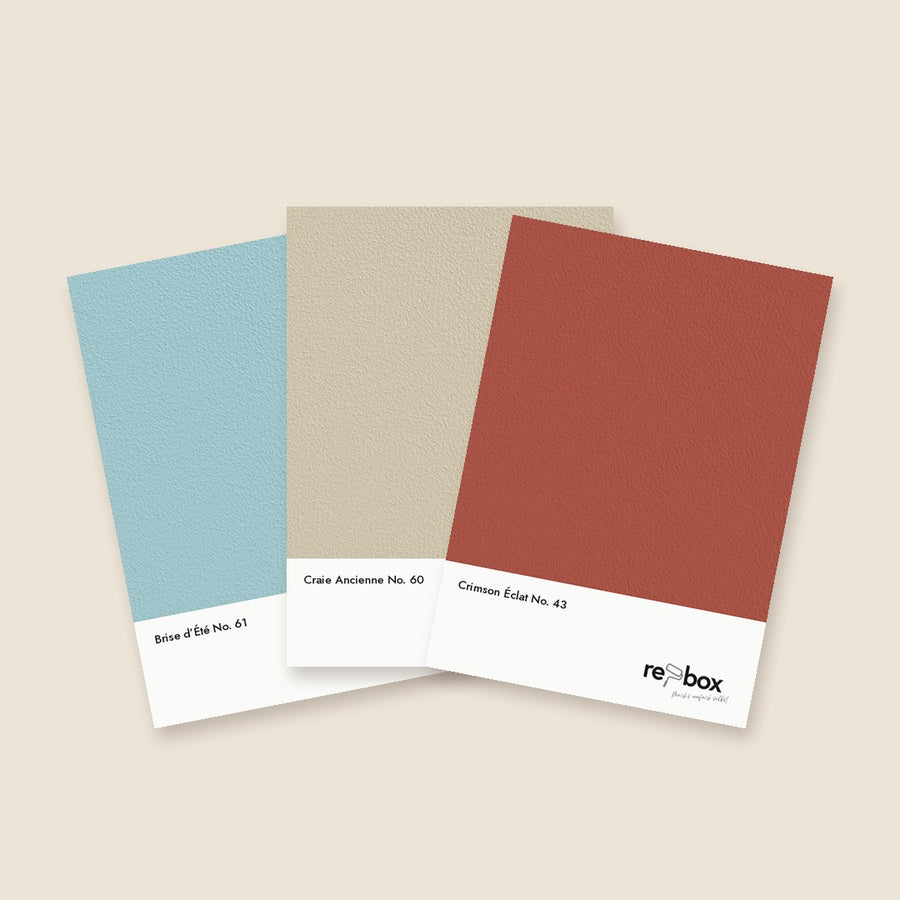
Popular at re-box isn't an editorial list — it's an analysis. The order is shaped by what people actually order most: 173 items, from a single shade of paint to the paint roller to a full renovation box. If you don't know where to start, this is the shortest way in: what others have already chosen.
Buy popular wall paints, lacquers and painting tools
This category brings together three groups of products that end up in the same trolley on any real project anyway. First, the paint: 65 colour names come in two versions, once as wall paint and once as lacquer. Every wall shade comes in 2.5, 5 and 10 litres and in two finishes, matt or silk matt. Second, the tools: rollers, frames, brushes, trays, telescopic poles. Third, the boxes, where both are already put together for you.
Every colour is mixed individually only after you place your order, even the white shades. That's why there are no leftover batches here, and why delivery takes 3 to 5 working days from receipt of payment. All wall paints are water-based and low-emission, made in Germany.
Which shades end up in the basket most often
The order of this category reveals more about the taste of re-box customers than any color of the year. Four groups keep coming up again and again.
Light shades that work in almost any room
At the very top are the shades you can hardly go wrong with. Craie Ancienne No. 60 leans toward an old-fashioned limewash and feels softer than a plain white. Bone China Glow No. 12 is the shade for anyone who wants it light but not cool. Sel Marin No. 54 is the lightest of the three. All three sit well with oak, linen and white ceilings — and all three look different in lamplight in the evening than at the window at midday.
Grey and stone for calm walls
Dove Horizon No. 26 is a dove grey that doesn't tip into blue. Chalkstone No. 16 picks up the chalky direction and stays lighter. Stonecellar No. 17 is the darkest of the group and looks great on a single wall behind a sofa or bed. Grey shades are demanding in north-facing rooms: without warm counterweight from wood or textiles, they quickly feel stark.
Blue, from pale to midnight
Blue is the family that gets played through most thoroughly in this shop. Fjord Mist No. 39 is a restrained, misty start. Azure Bay No. 25 is unmistakably blue. Baltic Midnight No. 24 is the dark end of the range: a shade for rooms where evenings happen, not mornings.
Shades that are a decision
Among the colour shades, Blooming Tisane No. 37 is the first to appear in this category — it's the wall shade sitting right at the top here. Matcha Bloom No. 9 brings green into the room without raising its voice. And Gutter Black No. 33 is the black option for niches, back walls and doors. With these three, a sample is worth more than with any of the others — they forgive less.
Why so much tools appear in the bestseller list
What stands out in this category is that paint and tools rank roughly equally high. The reason is simple: a good paint on a bad roller becomes a mediocre wall. The most frequently bought are the large 25 cm rollers for surfaces and the small 11 cm ones for edges, niches and everywhere behind the radiator. If you're painting a ceiling, add a telescopic pole and skip the ladder. The full range is available under Paint Rollers.
The second reason is restocking. Frames last a long time, rollers don't. That's why replacement rollers regularly turn up in the second order — and if you grab an extra one the first time round, you won't have to stop mid-project. For how to keep it streak-free, see the magazine article Painting walls without streaks.
The boxes: renovating as a package
A large share of orders don't come through individual items but through the renovation boxes. The idea behind them is simple: instead of hunting down twelve items one by one, you get everything you need for a project — kitchen, furniture, staircase, doors — in one package. That removes the most common frustration from a project: the missing little thing on a Saturday afternoon.
One note belongs here: if a box contains mixed paint, the entire box is excluded from returns. This isn't a clause buried in the fine print — it follows from the fact that every shade is mixed individually for you.
What wins in which room
Living room
Here, light and mid-tones win, often combined: three walls light, one darker. Matt is chosen more often than silk-matt: a large surface that barely reflects light calms the whole room.
Bedroom
The bedroom is the room where the darker blues and greens are chosen most often. The reason is when it's used: a room you mostly see in the evening and by lamplight can carry more depth than one that's flooded with midday sun.
Kitchen
In the kitchen, it's not the shade that decides but the finish. Silk-matt is the obvious choice here, since the surface next to the stove and sink regularly gets wiped down. The shade itself can still be bold — kitchen walls tend to be small, since cabinets cover half of them.
Hallway
The hallway is the most underrated room on this list. It gets little daylight, has plenty of edges, and takes the heaviest wear in the whole living area. That's why it's often painted silk-matt, in a shade two steps bolder than in the living room.
Matt or silk-matt — and how much you need per tin
Behind every matt shade is re-box base one (matt): interior paint for walls and ceilings, and at the same time the tinting base every shade is made from. If you want a surface that can take a wipe, go for re-box silk matte WHITE (silk-matt) — silk-matt, especially hard-wearing and very easy to clean. Since the price only depends on the quantity, this decision costs you nothing but a moment's thought.
For quantity, one figure helps: roughly 6 to 8 m² per litre and coat. Worked out for two coats, that means:
- 2.5 litres — for approx. 8 to 10 m² of wall area
- 5 litres — for approx. 15 to 20 m²
- 10 litres — for approx. 30 to 40 m²
Dark, strongly coloured or uneven surfaces use more. If you'd rather calculate than estimate, you'll find the formula in the magazine under How much wall paint do I need.
The same names also come as a lacquer
65 of the popular shades also exist as a lacquer tone. So the same shade is available for both: for the wall and for the piece of furniture in front of it. They're two different materials: the wall paint belongs on walls and ceilings, while the silk-gloss furniture and multi-surface lacquer goes on furniture, wood and interior surfaces. To see whether the combination works in your room, the best way is to lay both samples side by side. The range is available under Lacquer Colours.
Frequently asked questions about the most popular re-box products
What is this category sorted by?
By popularity, automatically. What gets ordered more often moves up — there's no editorial curation behind it. That's why the order shifts over time.
Can I test a popular shade beforehand?
Yes, with the Colour Sample Box 65 pcs. It contains all 65 shades as samples, so you can check them in your own light, at the window in the morning and by lamp in the evening. Because each shade is mixed individually for you, mixed paint is excluded from returns — so one evening with the samples saves real hassle.
How much do most people order?
That depends on the wall area, not the shade. For a single room with two coats, 5 litres is the most common choice; for a single wall, 2.5 litres is enough. If you're unsure, Anna, re-box's digital colour consultant, can help you with shade, finish and quantity.
Do tools and paint arrive in one delivery?
Yes, everything from one order ships together. Delivery takes 3 to 5 working days from receipt of payment, shipped within Germany by parcel. Processing starts once payment has been received in full.
Can I return a renovation box?
No, not once mixed paint is included. In that case the whole box is excluded from returns, because the shade was mixed specifically for you. Separately marked white goods without tinting can be returned, as long as they're undamaged and in their original packaging.
Why does tools appear so high up when I'm looking for paint?
Because most people need both together. If you're painting a wall, you order paint, roller, tray and covering material in one go — this is exactly the combination the sorting reflects.
Do I need a primer?
Not necessarily. On heavily absorbent or fresh plaster, it makes sense: it ensures even drying and reduces consumption. On sound existing paint, wallpaper or mineral surfaces, you can usually paint directly, as long as the surface is clean, dry and free of loose material.